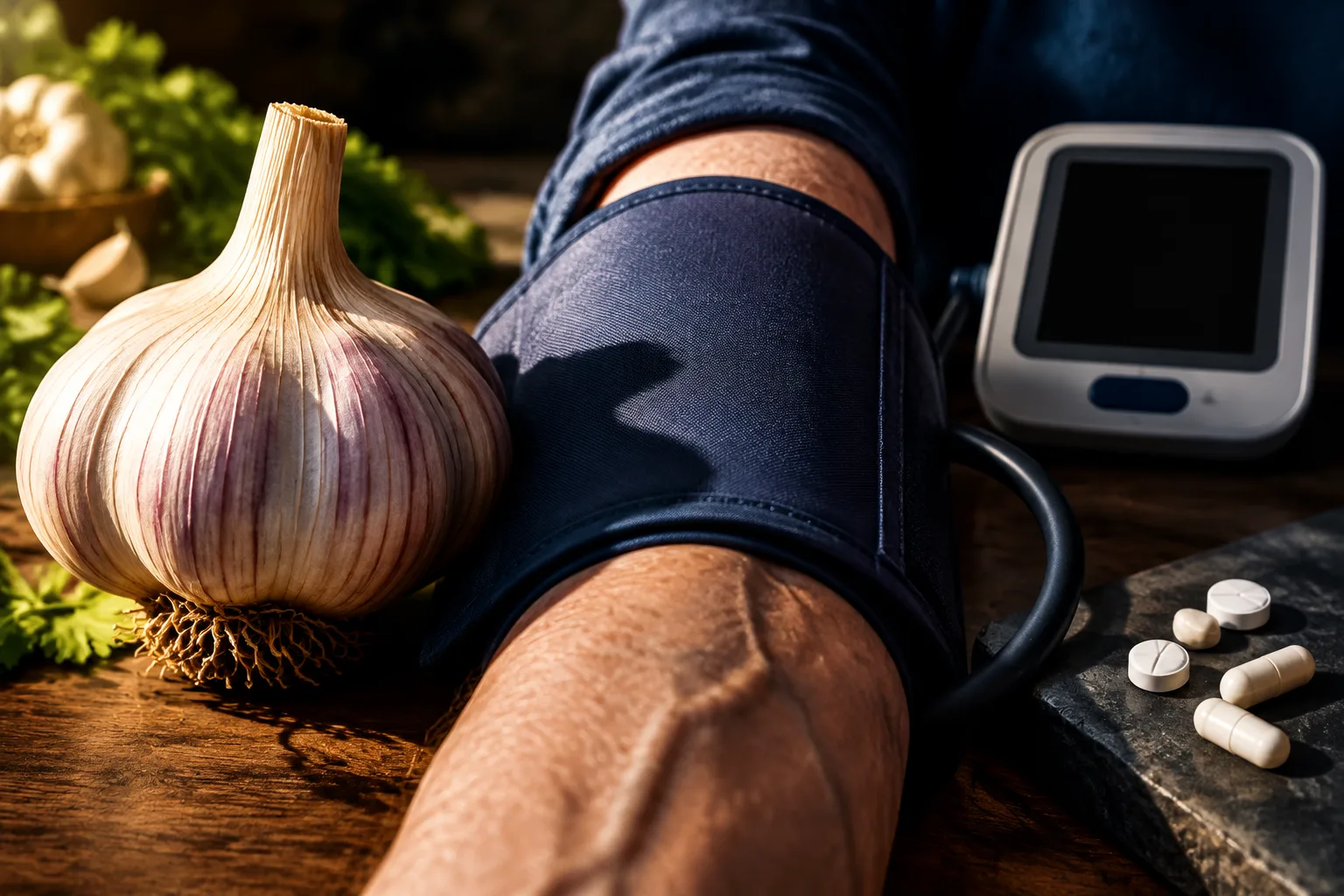
High blood pressure? Garlic widens blood vessels and improves circulation!
What do Natural Therapy Specialists write?
Garlic is described as a hypotensive agent, meaning that it lowers blood pressure.
Recent studies support the blood-pressure-lowering effect of garlic.
Garlic is listed as an agent that acts against high blood pressure.
Garlic widens blood vessels and improves blood circulation.
Wine with garlic added is said to stabilize blood pressure.
Blood pressure should not be lowered rapidly in older people with hypertension.
What does scientific research from PubMed · Europe PMC say?
We selected 7 studies with the best, positive results. This is a selection, not a full review of all research.
Total number of studies on this topic in PubMed: 76.
Aim of the study: There is no consensus based on the existing literature regarding the effect of aged garlic extract (AGE) on blood pressure. This systematic review and meta-analysis was conducted to synthesize existing data from randomized clinical trials (RCTs) concerning the impact of AGE supplementation on blood pressure in hypertensive patients.
Results: Overall, nine RCTs with 584 participants met the inclusion criteria. AGE supplementation reduced systolic blood pressure (SBP) (WMD: -4.03; 95% CI: -6.87, -1.20; I2: 57.1%) and diastolic blood pressure (DBP) (WMD: -1.44; 95% CI: -2.87, -0.02; P = 0.052; I2: 36.8%; P: 0.105). In addition, subgroup analysis indicated that higher doses of AGE supplementation significantly reduced DBP and SBP in hypertensive patients. The results of this study suggest that AGE supplements may help improve blood pressure in hypertensive patients, but significant effects were observed only at doses above 1200 mg/day. Well-designed future trials are needed to confirm these results.
“Not stated” does not mean nobody paid — the database does not always record it.
Aim of the study: To assess the effect, tolerability, and acceptability of aged garlic extract as an add-on to existing antihypertensive medication in patients with treated but uncontrolled hypertension.
Results: In patients with uncontrolled hypertension (SBP ≥ 140 mmHg at baseline), systolic blood pressure was, on average, 10.2 ± 4.3 mmHg lower in the garlic group than in the control group over the 12-week treatment period (p=0.03). Changes in blood pressure between the groups were not significant in patients with SBP<140 mmHg at baseline. Aged garlic extract was generally well tolerated, and acceptability of the trial treatment was high (92%). Our trial suggests that aged garlic extract is superior to placebo in lowering systolic blood pressure in patients with treated but uncontrolled hypertension, with effects similar to those of current first-line medications.
“Not stated” does not mean nobody paid — the database does not always record it.
Aim of the study: Hypertension affects 30% of adults worldwide. Garlic supplements have shown promise in treating uncontrolled hypertension, and their mechanism of action is biologically plausible. Our trial is the first to assess the effect of aged garlic extract on central blood pressure and arterial stiffness, which are considered important risk factors for cardiovascular illness.
Results: Mean systolic blood pressure was significantly reduced by 5.0±2.1 mmHg (P=0.016), and among responders by 11.5±1.9 mmHg systolic and 6.3±1.1 mmHg diastolic, compared with placebo (P<0.001). Central hemodynamic measures tended to improve more in the garlic group than in the placebo group, including central blood pressure, central pulse pressure, mean arterial pressure, augmentation pressure, pulse-wave velocity, and arterial stiffness. Although changes in other cardiovascular markers were not statistically significant because there were few participants in subgroups with elevated levels, trends toward beneficial effects of garlic were observed for the inflammatory marker TNFα, total cholesterol, low-density lipoprotein cholesterol, and apolipoproteins. Aged garlic extract was highly tolerable and acceptable, and did not increase the risk of bleeding in patients taking blood-thinning medication.
“Not stated” does not mean nobody paid — the database does not always record it.
Aim of the study: Background: Previous research suggests that Kyolic aged garlic extract is effective in reducing blood pressure in a large proportion of hypertensive patients, with effects similar to those of standard first-line antihypertensive medication. High blood pressure has been linked to gut dysbiosis, with a significant decrease in microbial richness and diversity in people with hypertension compared with those with normal blood pressure.
Results: Furthermore, aged garlic extract improved gut microbiota, as shown by greater microbial richness and diversity, with a marked increase in Lactobacillus and Clostridia species after 3 months of supplementation. Conclusions: Kyolic aged garlic extract is effective in reducing blood pressure in patients with uncontrolled hypertension and may improve arterial stiffness, inflammation, and the gut microbial profile. Aged garlic extract is highly tolerable and has a strong safety profile as a stand-alone or add-on antihypertensive treatment, with multiple benefits for cardiovascular health. Trial Registration: Australian New Zealand Clinical Trial Registry ACTRN12616000185460 (https://www.anzctr.org.au/Trial/Registration/TrialReview.aspx?id=370096).
“Not stated” does not mean nobody paid — the database does not always record it.
Aim of the study: The use of garlic (Allium sativum) to treat arterial hypertension has been recognized as effective for several decades. However, treatment tolerability is low, and several technological modifications have been developed to improve it, such as aging the garlic at controlled temperature and humidity.
Results: A reduction in systolic and diastolic blood pressure of 1.8 mmHg (0.7 to 4.1 95% CI) and 1.5 mmHg (0.3 to 3.0 95% CI), respectively, was observed. Blood nitric oxide increased (10.3 µM, 1.1 to 19.5 95% CI), as did antioxidant capacity (7 × 10⁻³ µM TE/min, 1.2 to 13 × 10-3 95% CI); uric acid levels decreased (-0.3 mg/dL, -0.5 to -0.001 95% CI), as did ACE activity (-9.3 U/L; -18.4 to -0.4 95% CI). No changes in endothelial function or inflammatory cytokines were observed. It was concluded that low-dose SAC supplementation in an optimized black garlic extract provides an additional significant reduction in blood pressure in people with grade 1 hypertension who are receiving drug treatment.
“Not stated” does not mean nobody paid — the database does not always record it.
Aim of the study: Forty-seven non-hospitalized patients with mild hypertension took part in a randomized, placebo-controlled, double-blind trial conducted by 11 general practitioners. After a two-week acclimatization phase, the patients included in the study had diastolic blood pressures between 95 and 104 mmHg.
Results: Significant differences between the placebo and garlic groups were found during the course of treatment. For example, supine diastolic blood pressure in the garlic treatment group fell from 102 to 91 mmHg after eight weeks (p less than 0.05) and to 89 mmHg after 12 weeks (p less than 0.01). Serum cholesterol and triglycerides were also significantly reduced after eight and 12 weeks of treatment. In the placebo group, by contrast, no significant changes occurred.
“Not stated” does not mean nobody paid — the database does not always record it.
Aim of the study: Hypertension is the most common preventable condition encountered in primary health care. If it is not treated early, it can lead to cardiovascular and kidney disease.
Results: A total of 200 participants were selected through purposive sampling and allocated to an intervention group (n=100) and a non-equivalent control group (n=100). The intervention group showed a significant reduction in mean systolic blood pressure from 152.34±8.76 to 128.45±6.23 mmHg and in diastolic blood pressure from 96.78±6.45 to 82.34±5.12 mmHg (p<0.001). Post-test blood pressure levels were significantly lower in the intervention group than in the control group (p<0.001). Thus, we show that consuming raw garlic cloves is an effective and feasible complementary strategy for managing hypertension in the community.
“Not stated” does not mean nobody paid — the database does not always record it.
Sources (13)
- Henryk Różański — Czosnek jako surowiec farmakopealny. Sproszkowana cebula czosnku – Allii sativi bulbi pulvis.
- Henryk Różański — Czosnek – Allium jako antiscleroticum i hypotonicum.
- Henryk Różański — Czosnek niedźwiedzi – Allium ursinum L. (Bärlauch) i czosnaczek pospolity – Alliaria officinalis Andrz. jako pokarm i lek.
- Henryk Różański — Czy czosnek (Garlic, Knoblauch) działa immunostymulująco?
- Michał Tombak — Myśl jest początkiem wszystkiego…
- Jerzy Jaśkowski — Podstawy fizyczne hemodynamiki cz. 2
- Effects of aged garlic extract on blood pressure in hypertensive patients: A systematic review and meta-analysis of randomized controlled trials. · Prostaglandins Other Lipid Mediat 2024
- Aged garlic extract lowers blood pressure in patients with treated but uncontrolled hypertension: a randomised controlled trial. · Maturitas 2010
- The effect of aged garlic extract on blood pressure and other cardiovascular risk factors in uncontrolled hypertensives: the AGE at Heart trial. · Integr Blood Press Control 2016
- The Effect of Kyolic Aged Garlic Extract on Gut Microbiota, Inflammation, and Cardiovascular Markers in Hypertensives: The GarGIC Trial. · Front Nutr 2018
- Antihypertensive Effects of an Optimized Aged Garlic Extract in Subjects with Grade I Hypertension and Antihypertensive Drug Therapy: A Randomized, Triple-Blind Controlled Trial. · Nutrients 2023
- Hypertension and hyperlipidaemia: garlic helps in mild cases. · Br J Clin Pract Suppl 1990
- Effectiveness of garlic clove (Allium Sativum) on blood pressure reduction among hypertensive patients. · Bioinformation 2026
Pisaczek does not judge who is right. It shows what was written and where to read it. Every sentence above has its source.